“It is about installing the operating infrastructure behind recurring revenue and guiding organizations through the behavioral shift required to sustain it.”
—Ruben Rabago
Operational Model
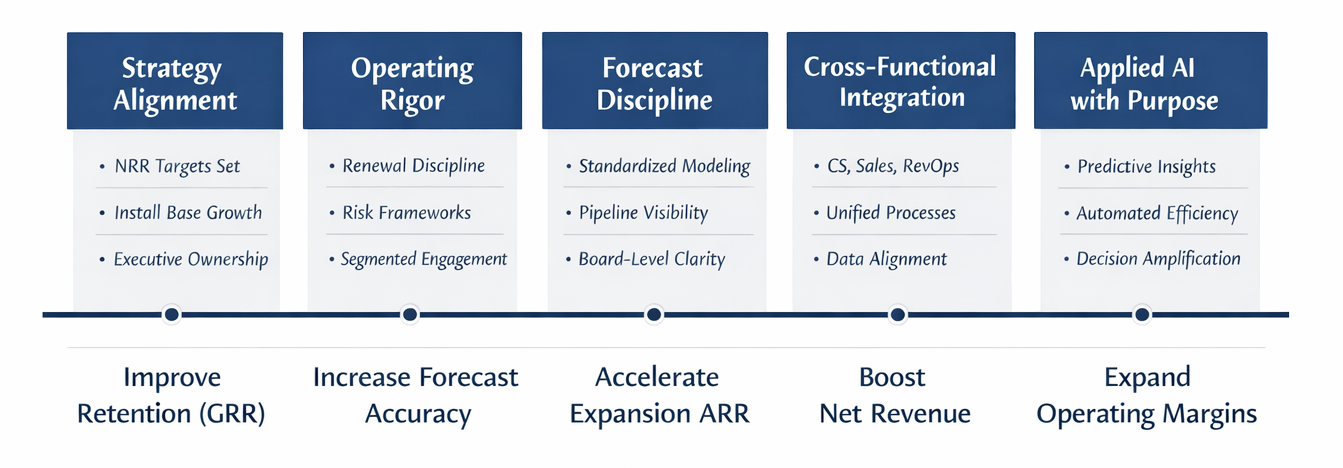
How the Model Becomes Institutional
PHASE 1 - Diagnostic and Executive Alignment
Revenue risk exposure assessment
Forecast accuracy evaluation
Install base growth opportunity analysis
Cross-functional friction mapping
AI maturity and impact assessment
PHASE 2 - System Design and Integration
Segmented engagement models
Renewal governance frameworks
Forecast standardization
Expansion accountability structure
AI use case prioritization tied to measurable outcomes
PHASE 3 - Executive Embedding
Leadership enablement
Reporting redesign
Board-ready forecasting models
AI workflow integration
Cross-functional accountability

An Informed View of Sustainable Success
Most organizations try to improve retention by making teams work harder.
More meetings.
More tools.
More dashboards.
More AI.
Effort rises. Predictability does not.
Customer Success rarely fails from lack of intelligence or commitment. It fails when operating discipline lags behind growth and new processes exceed the human capacity to absorb change.
Growth introduces uncertainty.
Uncertainty triggers threat responses.
Threat responses produce resistance.
Leaders call this lack of buy in. Often it is cognitive overload.
When forecasting models shift, accountability changes, or AI alters workflows, people instinctively protect autonomy, reduce ambiguity, and maintain control.
Without addressing the neuropsychology of change, even strong operating models stall.
Revenue predictability is behavioral as much as structural.
Retention must be structured.
Expansion must be systemized.
Forecasting must be governed.
AI must be applied intentionally.
But institutional change only succeeds when it is absorbed, not imposed. That requires clear narrative alignment, psychological safety in accountability, progressive capability building, and visible early wins.
Customer Success is not a cookie cutter playbook. Yes, there is a reference book with my name on it. But there is no rubber stamp and no easy button.
Real transformation happens when leaders engage the people who must operate the systems and adapt the change to the realities of each organization.
That is why my approach works and the impact endures.